The Language of Gesture in Nature and in Poetry
Christina Root
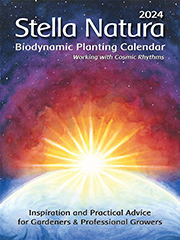
The following is an example of the articles to be found in the Stella Natura 2009 Biodynamic Planting Calendar
Those who plant by the stars and work with cosmic rhythms are challenged to be sensitive to the invisible as well as visible forces at work in the natural world. Sustaining attentive receptivity without falling into conventional patterns of thinking is part of the conscious participation in the processes of nature that the Biodynamic method asks of those who wish to live and work in harmony with the land. Habits of mind and of speech can make that process either easier or more difficult; developing flexible thinking and expression can help sustain new modes of consciousness that weave together the physical and the spiritual in ways that recognize the wholeness of phenomena not always seen as belonging together.
The famous poet/scientist Goethe (1749–1832) pioneered an approach to nature that can help with the process of flexible thinking, of staying open to natural phenomena and fusing the world of experience with the world of ideas. Rudolf Steiner made a life-long study of Goethe's work, appreciating his "delicate empiricism," an approach anchored in observing physical processes, which overcomes the dualism of the conventional scientific world view. Just as Biodynamic agriculture asks us to regard the farm as an ecosystem that includes the farmer, Goethe's approach stresses relationships among phenomena, including between the observer and the observed. His approach asks that we try to let the phenomenon think itself in us through a series of steps that involve a schooling of the observer, not as an onlooker, but as a participant in the processes going on around him or her, in the art of open-ended conversation with the phenomenon rather than in theory building.
As a poet as well as a scientist, Goethe was very sensitive to the role that language plays in our being able to articulate what he referred to as the "gesture" of the phenomenon under study. If we get stuck in a particular metaphor, he argued, we may miss much of what a phenomenon is trying to tell us. Whole bodies of knowledge may rest on the acceptance of particular metaphors of how nature works. For example, as Craig Holdrege and others have shown, metaphors of isolation and competition keep us from seeing dynamic relationships among natural phenomena. "Seeing" competition between individual organisms can be, in part, the consequence of imposing figures of speech. Part of the schooling in Goethe's approach involves a willingness to see with new eyes and to craft in fresh language what we see. Becoming aware of the centrality of language in our thinking can help us work more effectively with Goethe's method. Goethe himself worried about the possibility of successfully articulating the dynamic life of organisms in language without killing that life, but, of course, he persevered with enormous sensitivity, which makes him a very useful model in this regard as well as in so many other ways. Becoming flexible in the language we use, recognizing the power of particular metaphors, while at the same time appreciating the deeply metaphorical character of all language, makes us better able to enter into an open-ended conversation with the particular phenomena that we deal with both in gardening and in imagining solutions to large-scale environmental problems.
Art has always been crucial in helping us perceive the essential character and quality of a phenomenon – its entelechy, as Aristotle called it, or gesture. The best painting and sculpture captures the dynamic nature of a plant or animal despite the stillness of the canvas, wood or stone. Poetry, by contrast, is more likely to imitate the process of coming to such a gesture – the search for it rather than its achievement. That makes poems particularly helpful as guides to discovering gesture. They can help us recognize the things that must be considered in developing fluid thinking.
Because they exist also as forms in and of themselves, in addition to their subject matter (like any work of art), the process of reading and exploring poems is like the process of plant observation. Such exploration provides a schooling in following a line of thought and not engaging in arbitrary speculation. Interpreting a poem is an open-ended process, but not an "anything goes" one. Poems, then, can be used to orient and develop our thinking. Goethe's approach encourages the observer's striving to "become identical" with the contemplated object. Since communicating that oneness most likely involves language, it is fundamental that we develop a living relationship to words. Reading poems closely can help with that discipline.
Robert Frost's poems provide a perfect place to begin. First, he is famous as a poet whose poems come out of a deep relationship to the land. He, himself, tried his hand at farming – for ten years he farmed a property in Derry, New Hampshire left to him by his grandfather. Throughout this period he wrote many of his greatest poems, as though stimulated by the hard (and largely unsuccessful) work of cultivating the land. He was a true nature lover, both as tramper through the woods and as farmer. In his intimacy with nature, Frost was so sensitive to different ways of seeing the natural world, and his poems are so evocative and many-sided, that he has been variously interpreted over the years, as sharing Emerson's "cheerful monism," at one extreme, and, at the other, as adopting a deeply pessimistic attitude toward our capacity to grasp nature's meanings.
He is particularly helpful in a Goethean context because he does not have a functionalist's view of language – he valued poetry as much for its sounds as its sense. Rhythm was extraordinarily important to him. He used mostly one syllable words, not because he was interested in a faux simplicity, but because he wanted the reader to feel meter as a living process and not have it determined by the nature of the multisyllabic words. In the poem we are about to look at, 102 out of 122 words are monosyllabic.
"Hyla Brook" is a summer poem. It emphasizes how hard it is to think along with the seasons, rather than having a fixed notion that reduces a particular season to something static. The poem challenges us to think about how we regard a brook that has run out of "song and speed." Is it still a brook? Is it somehow still present in absence? What exactly is a brook? Is it an organism? Where does it end and its environs begin? Since water is so fundamental to life, to what extent should a brook be seen as part of the phenomena that exist around and through it, rather than as something separate? In other words, how large a phenomenon are we considering when we think about a brook – and to what degree is this particular brook "tangled up with the observer's individuality," as Goethe felt was true of all phenomena?
Hyla Brook
By June our brook's run out of song and speed.
Sought for much after that, it will be found
Either to have gone groping underground
(And taken with it all the Hyla breed
That shouted in the mist a month ago,
Like ghost of sleigh-bells in a ghost of snow) –
Or flourished and come up in jewel-weed,
Weak foliage that is blown upon and bent
Even against the way its waters went.
Its bed is left a faded paper sheet
Of dead leaves stuck together by the heat –
A brook to none but who remember long.
This as it will be seen is other far
Than with brooks taken otherwhere in song.
We love the things we love for what they are.
Contemplating an empty stream-bed is a common summer experience – knowing that it is a stream-bed and not simply a ditch involves remembering a time – perhaps merely a month before – when it rang with its own song of flowing water and shouting spring peepers, which themselves seemed, in the white fog that made everything indistinct, to be echoes of sleigh-bells in winter. The first line assumes the brook is still there – it has simply run out of song and speed. But if it is no longer a noisy running brook, what do we need to be able to grasp what it has become? The speaker looks for it in new forms, just as Goethe came to see the leaf through its transformations into bud, flower and seed. Goethe's insight, discovered looking at plants in the gardens of Palermo, and documented in his Italian Journey, states that the gesture of plants is not best understood as if the plant were proceeding additively, but, rather, growing from the inside out, through a series of metamorphoses. Similarly, this stream, even if not an organism in the sense that a plant is, has undergone a metamorphosis rather than simply disappearing, and we need to look with the mind's eye to be able to see what happened to it.
The poem suggests that the brook has gone underground and/or manifested itself as jewel-weed (literally "come up in"), the weak foliage of which betrays its character as mostly water. Those observations/imaginings suggest the nature of the physical transformations of the brook. There is still, however, the now empty bed to consider. The feeling of absence seems part of the experience, even when the imagination helps us see the brook as taking on a new form or moving vertically as well as away. In contemplating the scene the speaker follows the lead of now latent metaphors. If the brook flows through a "bed," this bed has a "sheet" made up of dead leaves. These leaves, stuck together by the June heat, resemble paper, and, in fact, in English, beds and paper share the term sheet. And, of course, the pun leads to other associations: the term "leaves" applies to books as well as plants, and the stream-bed that looks as if it were covered with a paper sheet is about to become part of a poem in a book. The second half of the poem fuses the language of books with the language of brooks.
The speaker relies on memory to see what is before him, and in so doing he is re-creating the brook in his consciousness in ways very similar to the method prescribed by Goethe for capturing gesture, the process he calls "exact sensorial imagination." This method involves recreating in the imagination as precisely as possible the phenomenon observed. If that thing is fleeting and is actually not a thing at all but a process, both aspects of phenomena that Goethe addressed, there may be a moment when it only exists in memory and not in the physical world at all. Frost's brook achieves a reality in consciousness, where it can be imagined and followed in a way that would be impossible were the observer to rely only on what is physically before him in space at a particular moment.
With the phrase "this as it will be seen" Frost suggests that the word "this" can do double duty and refer to the poem as well as to the brook. The poem puts its emphasis on an un-brook-like moment in its various stages of transformation while some brooks are "carried otherwhere" in the songs of other kinds of poems that capture more conventionally archetypal stages in a brook's life.
The poem begins and ends with free-standing sentences, each of which lasts only a single line. The first sentence initiates the speaker's contemplation of the brook and seems fairly specific. The last sentence seems more aphoristic, almost proverb-like, as though it were the "message" of the poem, literally spelled out in words of one syllable. That message may seem somewhat surprising: "We love the things we love for what they are." Given that the poem has explored what an open-ended and challenging process coming to understand what something is can be, the last sentence seems oddly definitive. The reader, especially if scientifically inclined, might be suspicious of the seemingly conventional poetic practice of slipping love into an otherwise objective attempt to observe and understand a natural phenomenon. Isn't love just the kind of vague term that keeps art and science at such a distance from each other? Has Frost made too big a leap in his summing up of his experience? And, finally, is the observation itself tautological, not in fact telling us anything new?
Let's remember a point made earlier: that it is helpful to look at poems as well as natural phenomena as organic wholes, with their own integrity and "is-ness." If we make the kind of effort that the speaker has made in the poem up until the last line to understand the larger context of the brook in both time and space, we can think best how to understand that line in the context of the poem as a whole – as relating to what has preceded in a holistic way rather than as an aggregate. We can begin by saying that the kind of attention that he has brought to the brook even in its diminished state has produced a kind of love that accepts each stage – a love that doesn't demand that everything look like its archetypal self from moment to moment. The last line may signify that living into the processes of nature involves a kind faithfulness to the integrity of the ways its processes manifest.
Still, the line seems a little out of place unless we go back and see how it may actually have been prepared for. One possibility lies in the presence of the frogs whose chorus was so integral to the brook in spring and now is also absent. The frogs' silence seems synonymous with the disappearance of the water. And the brook has been named after the frogs, suggesting a close association of the two.
The term Hyla, which spring peepers were for a long time officially classified as, in addition to a scientific designation, introduces mythic resonances into the poem that carry with them ideas of love and longing. The story goes that Heracles spared the life of a youth, Hylas, captured in battle and, growing fond of him, kept him with him as a page. In their travels, they stopped on the island of Cios, and Hylas went to look for water. The nymphs of the spring he found fell in love with his beauty and drew him down into its watery depths, and he was lost forever to the world above. Heartbroken, Heracles searched for him fruitlessly, he and his men repeatedly shouting his name. To commemorate the tragedy, the island of Cios held a ritual each spring of calling for Hylas, a sound still echoed in the song of the spring peepers. The myth may help explain Frost's rather odd depiction of the frogs as shouting.
Perhaps there is something natural, then, in the speaker's longing – as natural as the disappearance of the water itself. A longing for water, for the springs of life, may be expressed in the jewel-weed's leaning back toward the brook's origins rather than forward to wherever "its waters went." In the poem, the feelings associated with the scene are muted but nevertheless present: the speaker participates in a series of transformations, each of which is natural and inevitable, but that is not to say that those transformations are experienced as neutral. There may be a feeling level of the phenomenon itself, which the myth may help us get to rather than its simply being imposed on or decorating nature.
Hyla frogs may originally have been classified scientifically referring to the mythic figure Hylas because, while they make their home in trees, they lay their eggs on the boggy bottoms of ephemeral ponds (and apparently brooks). Their young hatch deep in the mud. In addition, they are very elusive, so good at camouflaging themselves they are almost impossible to see. Because of this, they are identified primarily by their call. These characteristics suggest both Hylas and Heracles searching for Hylas. Things are more than one thing always. To love them for what they are involves using what Goethe called a "multifold language," resisting single or reductive forms of expression. Here such a multifold language involves the possibilities inherent in ordinary language to evoke the ideas in things as well as their physical nature. The poem invites us to contemplate the mood of a place, as not belonging solely to the poet, and in so doing, helps loosen the hold of purely functional explanations of nature, and mechanistic forms of objectivity. "Those who remember long" also remember a time when the natural world was alive with beings and expressed in the language of myth. We have no actual memory of such a time, of course, but it has lived on in poetry and song. Hearing those resonances helps us to see things as more than things.
Frost considered metaphor as part of the living processes of the world. He called metaphor "a very living thing. It is as life itself." Metaphor, the saying of one thing "in terms of another," is, according to Frost, "the height of poetry, the height of all thinking…" It is the "attempt to say matter in terms of spirit and spirit in terms of matter." That is the challenge the speaker takes on in "Hyla Brook," and the challenge that Goethe's phenomenological approach offers each of us who wish to understand nature more holistically.
Works Cited
Frost, Robert. Selected Prose of Robert Frost. Ed. Hyde Cox and Edward Lathem. New York: Holt, Rinehart and Winston, 1966.
Frost, Robert. Early Poems. Ed. Robert Faggen. New York: Penguin Books, 1998.
Holdrege, Craig. "Where Do Organisms End?" In Context (Spring, 2000).
Now Available
9" x 12" wall calendar
Beautifully illustrated
40 pages, 4-color cover
$14.95 retail; ISBN
978-0-9795530-2-8