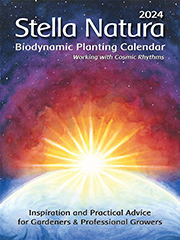
Stella Natura 2008
Planting Charts and Thought-Provoking Essays on the Theme of Biodynamics in Context
Edited by Sherry Wildfeuer
Exciting Changes!
From 1978 until 1995, the Stella Natura (originally known as the Kimberton Hills Agricultural Calendar) was published at Camphill Kimberton Hills. Beginning with this year's number, our community is once again taking on full responsibility for the calendar. As we do so, we look forward with excitement to the prospect of carrying the impulse of biodynamics and anthroposophy to a wider public.
Our New Articles Will Inspire and Guide
The human actions that have shaped current conditions in nature stem from social, economic, and scientific thinking based on a materialistic world view. This year's Stella Natura articles examine these fundamental assumptions and offer new insights to help us shape the field of agriculture for a healthier future. The pieces include:
SAVING THE PLANET IS MORE THAN A PRACTICAL PROBLEM, by Patrick Holden, director of the Soil Association in Britain, turns to the need in the organic movement for the guidance of spiritual insights: "…It is not enough to simply farm biologically. I'd even go so far as to say that if the whole world converted to organic farming without a corresponding inner human dimension that this would be a somewhat empty victory….one cannot leave out the person from the farming system." He calls for a collaboration of the organic and biodynamic movements on this deeper level.
Two articles on Carbon in agriculture, CARBON CYCLES IN FARMING AND COMPOSTING, by Will Brinton, Ph.D. and CARBON, THE FORGOTTEN ELEMENT, by Kyle Holzhueter, M.S. explore the role of carbon in soil and plant life and the question of carbon emissions into the atmosphere caused by agriculture.
Mark Moodie describes his web site "Considera," which is designed to collate, analyze, and share the results of experiments based on the use of Stella Natura and the biodynamic preparations. This allows those who cannot devote their working lives to research but who can manage perhaps one modest experiment per season to participate in the development of this science, which is still so new.
In NATURE vs. AGRICULTURE?, Ethan Roland takes us from the cutting-edge of conventional fruit production in Chile to the wild apple forests of Kazakhstan. As a teacher of Permaculture Design, he tells how he is working with a biodynamic farmer in the Hudson River Valley to enhance the vitality of his orchard, leading it towards not merely sustainability but a capacity for holistic regeneration.
Gary Lamb tackles the issue AGRICULTURE AND ITS RELATION TO GOVERNMENT. He describes the current situation in the US and goes on to elaborate, through the sociological insights of Rudolf Steiner, what the ideal relation of government to agriculture should be – radical and thought-provoking.
Ted McGlone, Ph.D., professor of Economics, offers a historical perspective to Steiner's social ideas in A BRIEF HISTORY OF ECONOMIC THOUGHT FROM ADAM SMITH TO RUDOLF STEINER.
Ellie Kastanopolous and Rebecca Fletcher show how some of these new social ideals have been put into practice in THE LAND UPON WHICH OUR COMMUNITIES DEPEND. The Community Land Trust movement is described, with two wonderful examples.
Since agriculture is all about providing food for people, it is important to include the subject of nutrition. In THOUGHTS ON STARCH FROM A BAKER'S PERSPECTIVE, Chris Stearn takes a deeper look at the impulse behind a "low carb" diet. He explains the glycemic index, points out the differences among the grains, and shows how the baking process transforms the flour into bread.
In his article, TOWARD A LOCAL FOOD SYSTEM, Joe Angello, founder of Angello's Distributing, Inc., explores what it will really take to make the phrase "Buy Local" a reality. The efforts needed from growers, distributors, retailers, and consumers are described in detail, based on the author's practical experience.
Now Available
9" x 12" wall calendar
Beautifully illustrated
40 pages, 4-color cover
$14.95 retail